

Selective and Effective Itch Relief for Atopic and Allergic Dermatitis
When it comes to canine itch relief, it pays to be picky.
Over the years, our understanding of the mechanisms and immunology underpinning atopic and allergic dermatitis has continued to develop, widening the portfolio of treatment options available to veterinary professionals.1
Treatment used to be reliant entirely on non-selective medicines, such as antihistamines, steroids or ciclosporin, which still have a place in modern treatment plans. However, there are notable drawbacks to these options including lack of evidenced relief, undesirable side effects, unreliable absorption and/or inconvenient dosing schedules.2
The introduction of Janus kinase (JAK) inhibitors marked a revolution in the treatment of atopic and allergic dermatitis flares, offering a targeted treatment approach to the control of pruritus for dogs, their owners and veterinary professionals.1 Yet even amongst JAK inhibitor options, selectivity remains important.
Why Does Selectivity Matter?
Imagine taking an untrained dog for a walk without a lead. They are bound to get distracted and wander astray into unpredictable mischief. In a similar manner, a non-selective medicine in their body is likely to bind at unintended sites on its way to the intended target.3 In practice, these unintended interactions present as side effects.4
Similarly to our imagined walk, the consequences of these unintended interactions are not always unmanageable. But in certain clinical situations could lead to undesirable side effects.
Selectivity Amongst JAK Inhibitors
The Janus kinase family is one of ten recognised families of non-receptor tyrosine kinases (a type of enzyme). Mammals have four members of this family, JAK1, JAK2, JAK3 and tyrosine kinase 2 (TYK2).5
Each JAK is located at a cytokine receptor and aids in downstream signalling to create effects in response to cytokines.
For example, interleukin-31 (IL-31) is thought to be a key cytokine involved in atopic and allergic dermatitis. When IL-31 is released and activates receptors, this activates JAK1 which sends the signal downstream to mobilise immune cells, creating inflammation, pruritus and disruption of the skin barrier.6
Other JAKs have also been linked to effects on pruritus. But notably they are also involved in other important processes, such as haematopoiesis and regulation of immune responses.6,7
For more information about JAKs, check out our Lunch and Learn where Dr Stephen Shaw helps to further explain how they work and their clinical significance.
Introducing Numelvi® (atinvicitinib)
Numelvi has been developed as a highly selective JAK1 inhibitor, to help provide fast-acting itch relief with a favourable safety profile, that is also simple to use.8
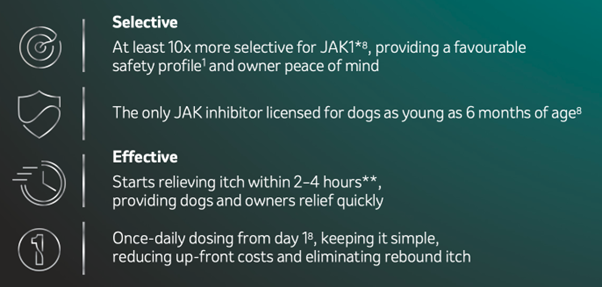 *Over the other JAK enzymes in in vitro assays.
**Based on a canine IL-31-induced pruritus model.
Learn more about selective and effective itch relief at uk.numelvi.com
Visit here
References
Prelaud P & Laprais A. What can we learn from canine atopic dermatitis history? Curr Dermatol Rep. 2020;9(1):52–57.
Drechsler Y, Dong C, Clark DE, et al. Canine atopic dermatitis: prevalence, impact, and management strategies. Vet Med (Auckl). 2024;15:15–29.
Mencher SK & Wang LG. Promiscuous drugs compared to selective drugs (promiscuity can be a virtue). BMC Clin Pharmacol. 2005;5:3.
Weinstein ZB, Kuru N, Kiriakov S, et al. Modeling the impact of drug interactions on therapeutic selectivity. Nat Commun. 2018;9(1):3452.
Yamaoka K, Saharinen P, Pesu M, et al. The Janus kinases (Jaks). Genome Biol. 2004;5(12):253.
Guttman-Yassky E, Irvine DA, Brunner PM, et al. The role of Janus kinase signaling in the pathology of atopic dermatitis. J Allergy Clin Immunol. 2023;152(6):1394–1404.
Hu X, Li J, Fu M, et al. The JAK/STAT signaling pathway: from bench to clinic. Signal Transduct Target Ther. 2021;6(1):402.
Numelvi® Summary of Product Characteristics.
Numelvi® tablets for dogs contain atinvicitinib. POM-V. Further information is available from the SPC, datasheet or package leaflet. Advice should be sought from the medicine prescriber. Prescription decisions are for the person issuing the prescription alone. Use Medicines Responsibly.
MSD Animal Health UK Limited, Walton Manor, Walton, Milton Keynes, MK7 7AJ, UK.
Registered in England & Wales no. 946942.
Copyright © 2026 Merck & Co., Inc., Rahway, NJ, USA and its affiliates. All rights
reserved.
UK-NUM-260300006