
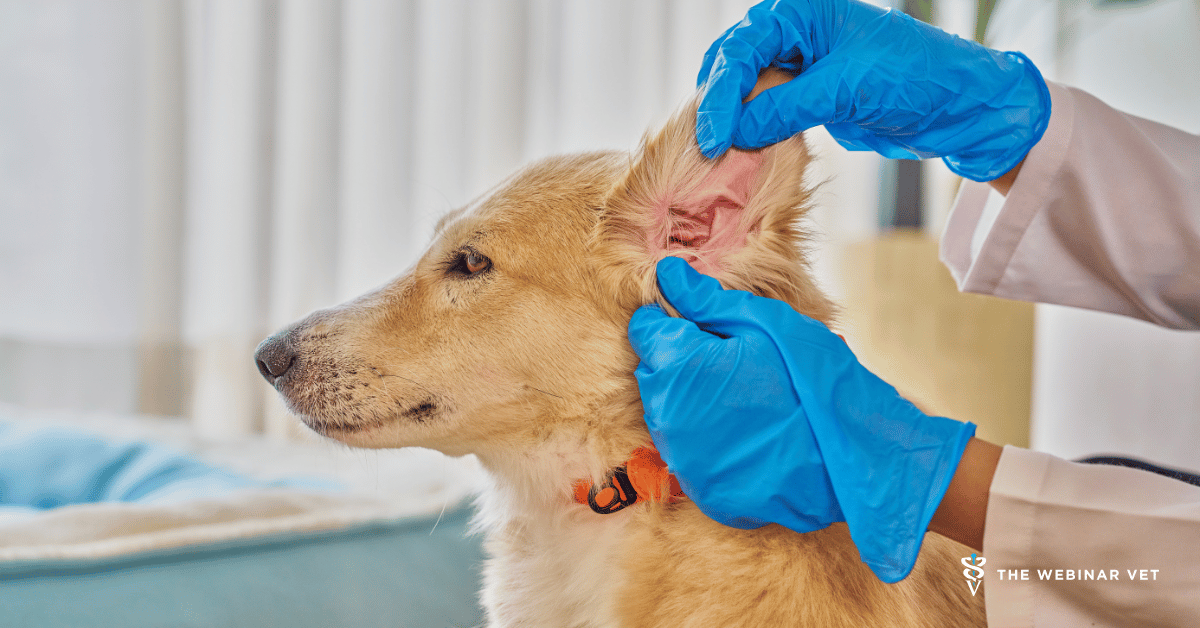
Canine yeast ear infections: Is there a path towards more responsible management?
By Alice LAURENS DVM, Independent Veterinary Journalist
All ears are not the same, and as such, there is not one single therapeutic option to treat otitis externa (OE) cases. Successful management of OE cases encompasses the diagnosis and management of the primary, underlying cause, the addressing of the acute inflammation, the systematic use of ear cytology to identify microbial overgrowth and judicious use of antimicrobials to successfully address any secondary microbial dysbiosis.
Whilst sole use of steroids is sometimes sufficient to treat uncomplicated cases of OE and paves the way to reducing unnecessary antimicrobial use, there is an unmet need for treatment of patients with more prominent yeast-only associated OE.
Yeast-only ear infections in dogs: how common?
Canine OE is frequently diagnosed1. Its aetiological factors are typically divided, using the PSPP system, into primary and secondary causes, plus perpetuating and predisposing factors2,3,4. Primary inflammation of the ear canal, sometimes accelerated by predisposing factors, can lead to loss of microbial diversity within the otic microbiome5,6 and subsequent secondary bacterial or fungal dysbiosis or infection.
OE presents across a wide clinical spectrum. The most common phenotype is erythroceruminous OE (ECOE), representing 80% of cases7, compared with suppurative OE8,9. ECOE is often associated with commensal microbial overgrowth, sometimes involving both yeast and bacteria10, while research suggests 40% of cases are associated with yeast-only Malassezia spp overgrowth7,8.
Malassezia spp. is commonly found in healthy canine otic microflora11,12. Disruption of ear microbiome homeostasis, often caused by primary inflammation, can allow Malassezia yeast to overgrow, causing secondary dysbiosis and/or infection and further driving ear canal inflammation12,13. Environmental conditions, such as humidity and heat, or host susceptibility can also contribute to yeast proliferation13, with Malassezia spp. overgrowth typically resulting in pruritic ECOE13.
Ear cytology is required to confirm the diagnosis and accurately identify the type of overgrowth, to allow the choice and implementation of a targeted therapeutic approach 9,12,14.
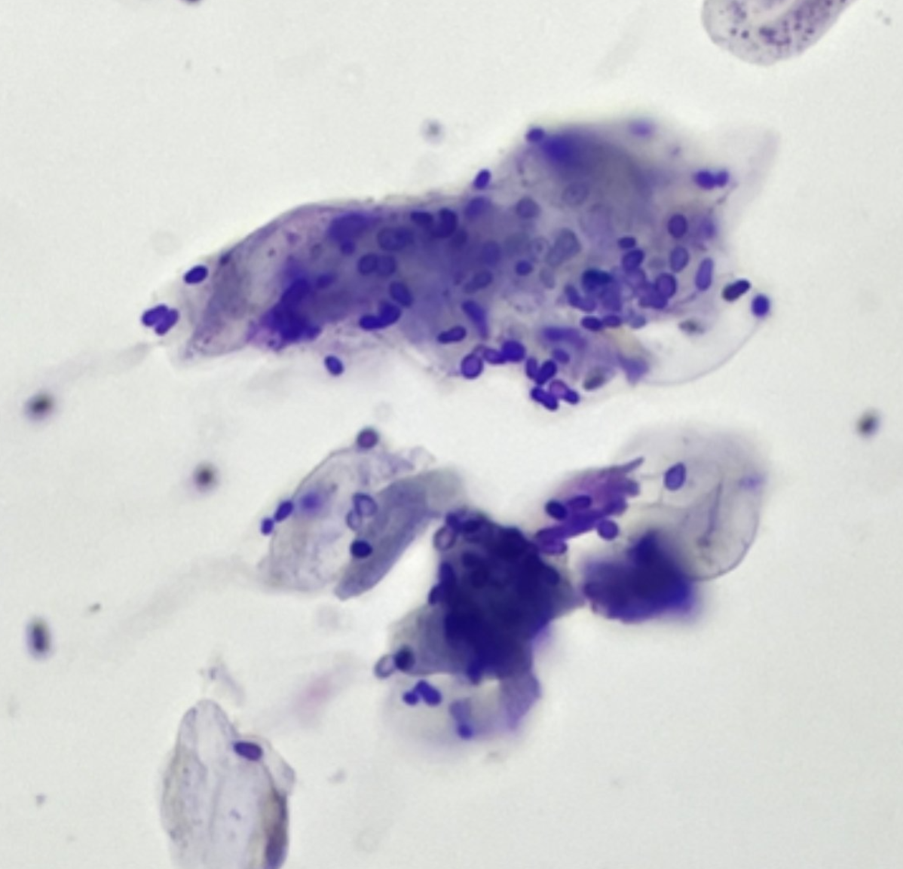
Photo 1. Cytological observation of Malassezia pachydermatis overgrowth in a dog with otitis externa (100x microscopy with oil immersion objective). Peanut shaped Malassezia yeasts are visible in clusters or adhered to keratinocytes. Photo credit: Klaudia Majcher
Current treatment options for yeast OE do not champion antimicrobial stewardship
Once yeast-only associated OE is confirmed by ear cytology, tailored treatment should be implemented. The diagnostic process should identify and address underlying causes, including primary disease, predisposing and perpetuating factors, to help prevent recurrent or relapsing infections3,4,9,13,14. Managing these triggers can significantly improve quality of life for patients and owners14.
Reducing inflammation, commonly associated with primary disease, is central to OE treatment and helps reduce clinical signs including pruritus, exudation and swelling3,9. Depending on severity, topical or systemic glucocorticoid treatment may be advised3, with topical therapy preferred where possible to avoid systemic effects.
Treatment choice should be guided by ear cytology confirming the presence of Malassezia spp. Cytology should be performed in all OE cases to identify the presence and type of microbial overgrowth and enable a targeted therapeutic approach.
Topical options are effective because Malassezia pachydermatis is superficially located within the stratum corneum13,15. Research suggests leave-in otic products offer higher quality of life than daily otic drops by supporting delivery of the required amount and concentration of actives16.
For yeast-only OE, all currently licensed topical products containing an antifungal also contain an antibiotic. In some uncomplicated ECOE cases, including those with yeast involvement, a licensed steroid-only product may be considered as an alternative to antimicrobials10. However, if a veterinarian decides an antifungal is required, there is currently no licensed topical antifungal option without concurrent antibiotic use, creating a clinical dilemma.
Introducing DuOtic
With a growing concern about antimicrobial resistance as one of the top global public health and development threats and increased pressure on the responsible use of antimicrobials, there is a hunger and a need for more targeted treatment options in cases of significant yeast overgrowth or Malassezia hypersensitivity.
A study comparing an antifungal agent with a combination product containing antifungal, antibiotic and corticosteroid agents for Malassezia species otitis in dogs showed greater effectiveness of the combination product in reducing clinical signs17.
In this study, the clinical efficacy of the combination product was attributed to the anti-inflammatory, antiproliferative and antipruritic effects of the steroid17. This supports the role of inflammation in canine otitis associated with Malassezia spp and the need for a combined topical product containing an antifungal and a steroid for yeast-only ear infections. Such an option would support targeted treatment without antibiotic use, reserving antibiotic-containing products for cases where they are deemed necessary.
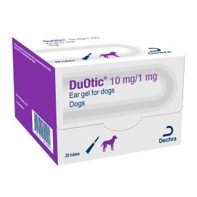 DuOtic is a steroid and antifungal combination indicated for the treatment of otitis externa (OE) associated with Malassezia pachydermatis that is now available.
A recent registration study demonstrated the efficacy and safety of the long-acting otic* gel in dogs with OE associated with Malassezia pachydermatis18. Administered by the vet in two doses, it can reduce caregiver burden and support a Lifelong Ear Partnership, which may be important for future case outcomes.
DuOtic enables targeted treatment of yeast-only ear infections without antibiotics, while supporting adherence and quality of life, as shown for another combination otic product administered using the same dosing regimen in practice16.
Summary
Cases of yeast-only associated canine OE are commonly seen by vets in practice. Most commercially available products are a triple combination of a steroid, an antifungal and an antibiotic.
With an increasing focus on the responsible use of antimicrobials, there is a need for more targeted treatment options. The arrival of DuOtic, combining a steroid and an antifungal, administered at the vet practice, helps reduce the unnecessary use of antibiotics and improves treatment compliance.
Learn more about DuOtic and the Otitis Externa support Dechra can offer through its Lifelong Ear Partnership initiative.
* DuOtic®, (Dechra BV), is an otic gel formulated in a single-use tube (1 mL), containing terbinafine (10 mg/mL) and betamethasone acetate (1mg/mL). DuOtic® is indicated for the treatment of otitis externa associated with Malassezia pachydermatis in dogs with one tube administered per affected ear repeated after 7 days