
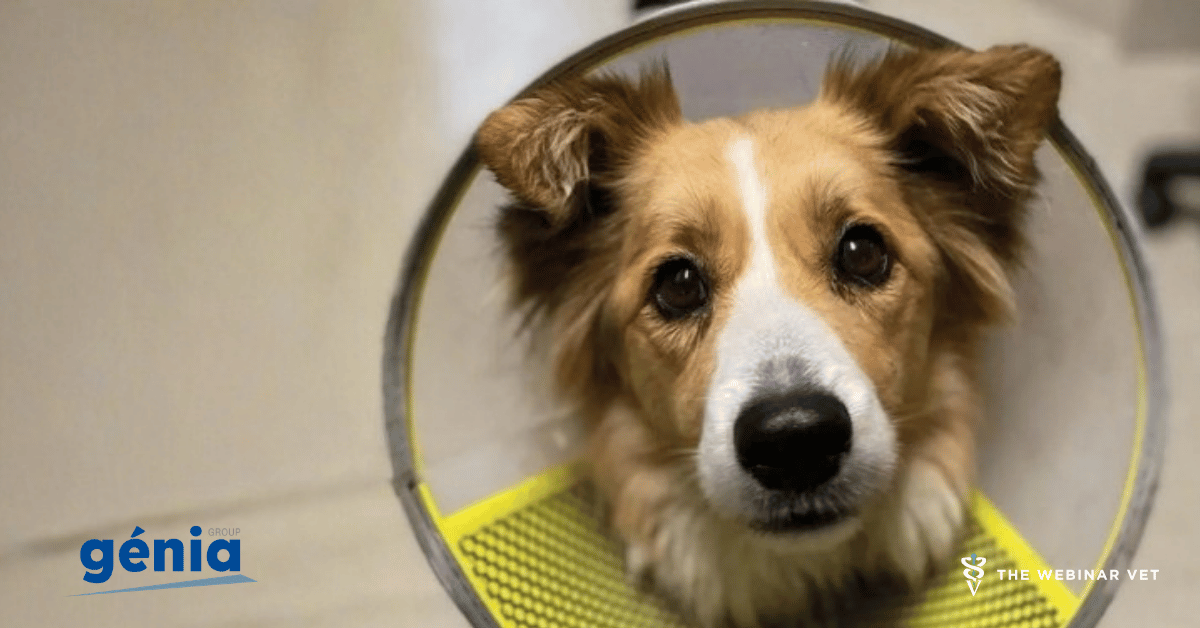
Calmer Recovery: A Vet Nurse's Guide to the Velfast® Recovery Collar from Génia Group
In conversation with Jenny, RVN CertVNECC, South West Sales at Génia Group
The recovery collar is one of the most-used pieces of equipment in veterinary practices. We sat down with Jenny, a Registered Veterinary Nurse and South West Sales at Génia Group, to talk about why the Velfast® collar from Génia Group is changing how clinics approach post-operative protection.
The traditional Elizabethan collar hasn't changed much in decades. What are the animal welfare issues this poses?
Most of us have watched a patient bump into doorframes, refuse to eat, or panic the moment the collar goes on. The rigid, unpadded design can rub, catch on wounds and add stress at exactly the point an animal needs to stay calm. From a welfare standpoint, recovery isn't only about the surgical site — it's about the whole experience. If a patient is distressed or the collar is causing secondary trauma, we're working against the very healing we're trying to protect. That's the gap the Velfast® was designed to close.
What difference does the padding in the neck make to patient recovery?
The Velfast® is padded at the neck, which matters more than people expect. For any patient with a wound on or around the neck — a lump removal, a bite injury, a dressing that needs guarding — a hard plastic edge pressing up against that area is the last thing you want. The soft padding distributes pressure gently and avoids pressing directly onto compromised skin.
What clinical difference does the self-fastening make?
This is the feature vets and veterinary nurses tend to appreciate most. Traditional collars must be pulled on and off over the head, which means manipulating the ears and face every single time. For a cat or dog with sore ears — think otitis cases, aural haematomas, post-aural surgery — that repeated handling is genuinely painful and stressful. The Velfast® fastens with a wide Velcro self-fastening, so you simply close it around the area and secure it. There's no tugging over the head, no forcing it past sensitive ears. For patients who don't tolerate much contact around their head, it's a far calmer experience.
You mentioned critical care earlier. Does the self-fastening Velcro design help with catheters?
Absolutely. When a patient has a jugular catheter in place, the last thing you want is a collar dragging or pulling around the neck dressing. With a conventional Elizabethan collar, you're manoeuvring it over the head and past the site every time it goes on or comes off, which risks disturbing the catheter and the dressing. Given that the Velfast® wraps and secures with Velcro, there's far less movement around the neck. You can position it precisely and adjust it without repeatedly disturbing the line. For anyone managing critical care patients, that reduction in handling around a vulnerable site is a real safety benefit.
Is there anything in the design that helps the human side of care?
Yes, and it's one people don't anticipate. The Velfast® is padded at both ends, not just against the animal. Anyone who has carried a rigid, unpadded collar around a ward knows the pain of a hard plastic rim catching their shins as a patient walks past. It sounds minor, but bruised shins are a genuine occupational hazard for nurses and pet carers. The padded outer rim takes the edge out of those knocks — a small thing that adds up across a busy shift.
Brachycephalic patients can be tricky to fit. How does the Velfast® help?
Brachycephalic breeds can be a real challenge — short muzzles, broad necks and a head shape that doesn't suit a one-size-fits-all approach. The 8 sizes in the Velfast® range (7.5 cm, 10 cm, 12.5 cm, 15 cm, 17.5 cm, 20 cm, 25 cm, 30 cm) give you a broad span of adjustment, so you can achieve a secure, comfortable fit on a French Bulldog or Pug without it being too loose to work, or too tight to tolerate. Being able to fine-tune the fit is a big advantage for these patients, who are already at higher risk of respiratory and stress-related complications. We’re also working on a range of Velfast® collars specifically tailored to brachycephalic patients to ensure these breeds are approached in the most welfare-led way possible.
Where are veterinary practices able to find the Velfast® range?
For clinics that want an efficient and welfare-focussed way of treating neck wounds, sore-eared patients, brachycephalic dogs, critical care lines — the Velfast® can make a real difference. You can find the full Velfast® range and specifications at Génia Group, or contact one of the MDC by Génia Group team, who are always happy to talk through which options suit your practice.
Génia Group has spent over eighty years designing veterinary products around real clinical needs, and the Velfast® is a perfect example of that approach.